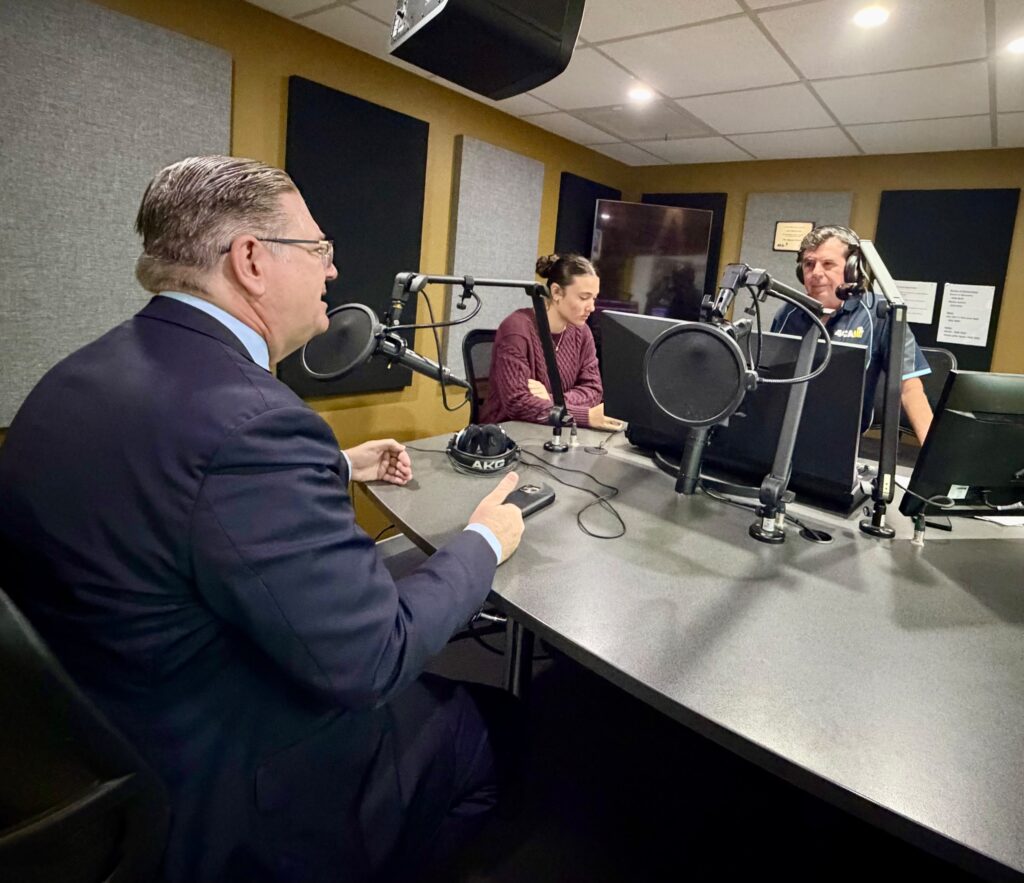
Aviation is incredibly important, particularly here in our part of the world, but right across the country as well. Getting the framework around aviation right is just as important. My special guest this morning is Queensland Senator Paul Scarr, who is in the studio. Good morning, Paul. How are you today?
Senator Paul Scarr: Great to be with you, Murray, and great to be in Cairns again.
Murray: Nice to have you back. I understand you’re here, along with three other senators, for discussions about aviation.
Senator Scarr: That’s right.
Murray: Let’s start with Cairns’ role in aviation. We know a number of airlines in Southeast Asia see Cairns as an attractive first port of call into Australia. Rather than international visitors flying into Sydney or Melbourne and then travelling north, Cairns can be a gateway to the country.
It’s something we should be encouraging, and I believe it’s been a focus during your visit over the past few days.
Senator Scarr: Absolutely, Murray.
We had a very productive visit to Cairns Airport, including the Aviation Skills Centre and the maritime and aviation search and rescue operations based in Cairns.
The visit really reinforced for the four senators here the importance of Cairns as a gateway to Australia, not only for aviation but also for the critical services provided throughout the Pacific region, including support for our Pacific neighbours through air and sea search and rescue operations.
Murray: Aviation is critical when it comes to servicing such a large and diverse area. I was just talking about the emergency alert system before you arrived. There were people in remote parts of Cape York who didn’t receive alerts because of connectivity issues.
When it comes to healthcare, emergency services and general connectivity, aviation really is key.
Senator Scarr: Absolutely.
One of the issues we’re focusing on during today’s Senate committee hearing in Cairns is transparency around the cost of providing aviation services to remote communities across Queensland, including Cape York.
We need greater transparency about why airfare prices can fluctuate significantly from week to week. That’s one of the issues we’re examining.
Murray: And certainty is important too. People in those remote communities rely heavily on smaller airlines. I guess this extends right across the country.
You have concerns that there isn’t enough certainty in the current legislative framework governing aviation in regional Australia?
Senator Scarr: Absolutely. We think much more work needs to be done.
We also need to look at airport infrastructure in remote locations. Investing in infrastructure at smaller airports can increase the range of aircraft able to operate there and improve service options.
Issues such as whether aircraft can be parked overnight are also important. There is a broad range of matters we need to consider, including legislation and infrastructure.
Murray: Here’s a tricky one for you, Paul. What exactly is the definition of airport services?
Senator Scarr: That’s an excellent question, Murray, and a very topical one.
Airports provide a wide range of services, and one challenge is how those costs are distributed. If you’re operating a small regional airport with far fewer passengers than Brisbane, Sydney or Melbourne, you don’t have the same volume over which to spread costs.
That includes security expenses. If a regional airport is expected to provide the same level of security screening and services as a major capital city airport, how can those costs be sustained without millions of passengers moving through the terminal every year?
Murray: Security is absolutely essential, regardless of whether you’re operating a small regional airport or a major international gateway.
Senator Scarr: Absolutely.
The question is how we ensure the costs of those services are distributed fairly across Australia so regional and remote airports are not carrying a disproportionate burden.
We need to make aviation as affordable and accessible as possible for Australians, wherever they live.
The average person in Cairns travels by air around three times more often than the average person in Brisbane, and that’s an important consideration.
Murray: Let’s look at the national picture.
Since COVID, we’ve heard plenty of stories from travellers struggling to get refunds or fair outcomes when flights are delayed or cancelled. It can be very difficult for consumers dealing with large airlines.
Do passengers need stronger protections?
Senator Scarr: Absolutely, Murray.
We need a system where passengers are fairly compensated when flights are delayed, cancelled or altered in a way that causes them financial loss.
People enter into a contract with an airline to provide a service. If that service isn’t delivered in accordance with the agreed terms, there should be appropriate compensation.
We need legislation that provides strong consumer protections and ensures people are treated fairly in those circumstances.
Murray: Sometimes delays are unavoidable because of weather or other factors, but there needs to be some balance. There can be a significant power imbalance between large airlines and individual travellers.
Senator Scarr: Exactly.
And if compensation is provided, it needs to be meaningful and usable. Providing a voucher that can only be redeemed at a specific time or under restrictive conditions isn’t always practical.
That’s another issue we need to examine.
Murray: As we wrap up this morning, there’s an aviation careers day coming up this weekend, which makes the timing of your visit particularly relevant.
Senator Scarr: Yes, and we had a wonderful tour of the Aviation Skills Centre at Cairns Airport yesterday.
More than 1,000 students have gone through the centre and gained aviation qualifications. Many have gone on to careers in the industry.
That’s everything from high school students through to apprentices, and many have secured jobs locally in Cairns.
I’d like to commend everyone involved with the Aviation Skills Centre. Their enthusiasm and passion are absolutely infectious.
If you’re a young person listening today—or even if you’re doing work experience in the studio, Murray—I’d encourage you to think about aviation as a career pathway.
Murray: I think she wants to be a Formula One driver, actually, but perhaps aviation might play a role along the way!
Senator Scarr: Very good!
And Murray, can I also thank Gary, my cab driver this morning? During our ten-minute trip, he gave me a comprehensive update on everything happening in Cairns.
Murray: Is that right? I thought that was supposed to be my job! Gary’s stolen my role.
Senator Scarr: No, no—you’d already given me the briefing before I came on air!
Murray: Queensland Senator Paul Scarr, great to talk to you this morning. Thanks very much for your time.
Senator Scarr: Thanks, Murray. Great to be with you.